
Roller Covers & Surface Materials
Material Selection Defines Roller Performance and Service Life.
Start Here
- Material Compatibility Select materials based on chemistry, temperature, wear, and operating conditions.
- Hardness & Durometer Understand how hardness affects compression, traction, and roller performance.
- Surface Finishes & Textures Explore finishes and textures for contact, transfer, release, and wear.
Failure Signs
Material Selection Directly Impacts Roller Performance and Service Life
Roller covering performance depends on chemical compatibility, thermal stability, hardness retention, compression characteristics, and wear resistance. Changes in these properties under operating conditions can affect traction, pressure distribution, release, surface quality, and process stability.
Common signs of material incompatibility or premature degradation include:
| Observed Condition | Potential Causes |
|---|---|
| Swelling, Softening & Tackiness | Chemical incompatibility with oils, solvents, cleaners, or process fluids |
| Cracking & Hardening | Thermal degradation, ozone exposure, aging, or material incompatibility |
| Premature Wear & Chunking | Abrasion, cutting, excessive loading, or insufficient tear resistance |
| Loss of Traction | Surface glazing, contamination, hardness changes, or inadequate friction characteristics |
| Sticking & Material Buildup | Insufficient release properties, surface finish, or chemical compatibility |
| Uneven Nip Pressure | Hardness variation, compression set, crown mismatch, or roller deflection |
We evaluate the material, surface, and operating conditions to identify the cause of premature wear or failure and recommend an engineered solution, often using the existing roller core.
Material Selection Process
Material Selection Based on Operating Conditions & Performance
Covering materials are selected or formulated based on chemical compatibility, temperature, loading, hardness, compression behavior, and wear requirements. Our material development process evaluates these factors to establish the appropriate compound specification.
When applicable, laboratory testing of existing coverings helps identify material characteristics, degradation, and potential causes of premature failure.
| Application Input | What We Evaluate |
|---|---|
| Temperature | Thermal stability, hardness retention, and compound compatibility |
| Chemistry | Chemical resistance, swelling, and material degradation |
| Load & Speed | Hardness, compression, heat buildup, and wear |
| Product Contact | Surface finish, release, and material compatibility |
| Roller Function | Traction, transfer, conformability, and surface performance |
| Failure History | Material condition, failure modes, and improvement opportunities |
Our in-house process connects compound development directly to manufacturing and inspection. From material mixing and batch testing to covering, curing, CNC grinding, and final verification, each stage is aligned with the approved specifications.
Material Compatibility Chart
Understanding Elastomer Performance by Application
Chemical resistance, thermal stability, hardness, compression behavior, and wear characteristics vary by elastomer family. Material selection depends on the specific operating conditions and performance requirements.
| Compound | Best At | Avoid | Typical Positions |
|---|---|---|---|
| Natural rubber (NR) | Resilience, tear strength, abrasion | Oils, solvents, long ozone exposure | General mechanical and web-handling positions |
| SBR and blends | Economical general-purpose abrasion resistance | Significant chemical exposure | Web handling, industrial positions with limited chemistry |
| Nitrile (NBR) and blends | Oils, greases, fuels, many solvents and inks | Ozone, weather, polar solvents | Printing, converting, oily industrial environments |
| Neoprene (CR) | Balanced: moderate oil resistance plus weather, ozone, flame | Strong oils and solvents | Mixed-condition positions |
| EPDM and blends | Water, steam, weather, ozone, acids, alkalis, polar solvents | Petroleum oils | PCB wet processing (develop, etch, strip), wet chemistry lines |
| CSM (Hypalon®) | Oxidizing chemicals, ozone, weathering, abrasion | Some solvents | Aggressive chemical environments |
| Silicone (liquid and gum) | High temperature, excellent release | Abrasion, tear, strong solvents | Heated lamination, heat-transfer, non-stick applications |
| Fluoroelastomer (FKM) | Highest heat, fuel, and chemical resistance | Cost where a lesser compound will do | Positions where other compounds break down |
| Polyurethane (cast and millable) | Abrasion, cut, tear, load | High heat, some hot wet environments | Drive, transport, material handling, wheels |
| Food-grade compounds | Positions that contact food or food packaging | Applications with no food contact requirement | Tissue and towel, food processing |
Specialty & Custom Formulations
When standard compounds do not meet application requirements, we develop custom formulations for specific chemical, thermal, mechanical, and surface performance needs. Applications include heat-resistant compounds for lamination, tacky coverings for web cleaning, and chemically resistant materials for demanding process environments.
Durometer Guide
How Hardness Influences Roller Performance
Cover hardness affects deformation under load, nip contact width, pressure distribution, traction, and wear resistance. Durometer selection must account for material type, loading, operating temperature, compression characteristics, and the function of the roller within the process.
How Hardness Affects Roller Performance
- Nip Width & Pressure Distribution: Softer coverings generally produce wider contact areas under equivalent loading, while harder coverings produce narrower contact areas and higher localized pressure.
- Conformability & Geometry: Softer compounds accommodate substrate variation, while harder compounds generally provide greater resistance to deformation under load.
- Traction & Grip: Hardness, compound formulation, and surface finish influence friction, material handling, and slip resistance.
- Wear Resistance & Heat Buildup: Hardness, compression behavior, and hysteresis influence internal heat generation, abrasion resistance, and covering service life.
Signs of Incorrect Hardness Selection
- Wrinkles or Uneven Lamination: Inconsistent nip pressure, inadequate conformability, or improper crown profile.
- Premature Wear or Heat Buildup: Excessive deformation, mechanical loading, or unsuitable compound properties.
- Slip or Traction Loss: Inadequate friction characteristics, surface condition, or hardness selection.
- Uneven Contact or Surface Marking: Improper compression behavior, nip loading, or covering hardness.
How We Determine the Right Durometer
We evaluate the roller’s function, operating load, nip requirements, substrate characteristics, temperature, and material properties before selecting or developing the compound. Our in-house material development and batch testing help maintain consistent hardness and compound properties.
Roller Durometer Selection Guide
| Durometer Range | Typical Behavior | Common Applications |
|---|---|---|
| Soft (20–45A) | Greater conformability, wider nip, gentle contact | Laminating, delicate substrates, cleaning |
| Medium (50–75A) | Balanced compression, traction, and resilience | Drive, pull, general nip rollers |
| Hard (80–95A) | Lower deformation, narrower nip, greater load resistance | Metering, calender backup, high-load applications |
Precision Surface Finishing & Specialized Profiles
Surface Finish & Profile Control for Critical Process Requirements
-
Ground Elastomer Finishes
Covers precision-ground to your diameter, profile, and surface texture on CNC cylindrical roll grinders.
-
Crowned Profiles
Convex and concave crowns offset deflection under load so contact pressure stays even across the face.
-
Micro-Grooved Surfaces
V- and U-shaped groove geometries for controlled coating and resist distribution, with groove depth and width verified before shipment.
-
Laser-Engraved Surfaces
Engraved patterns on chrome rolls for extrusion and specialty coating.
-
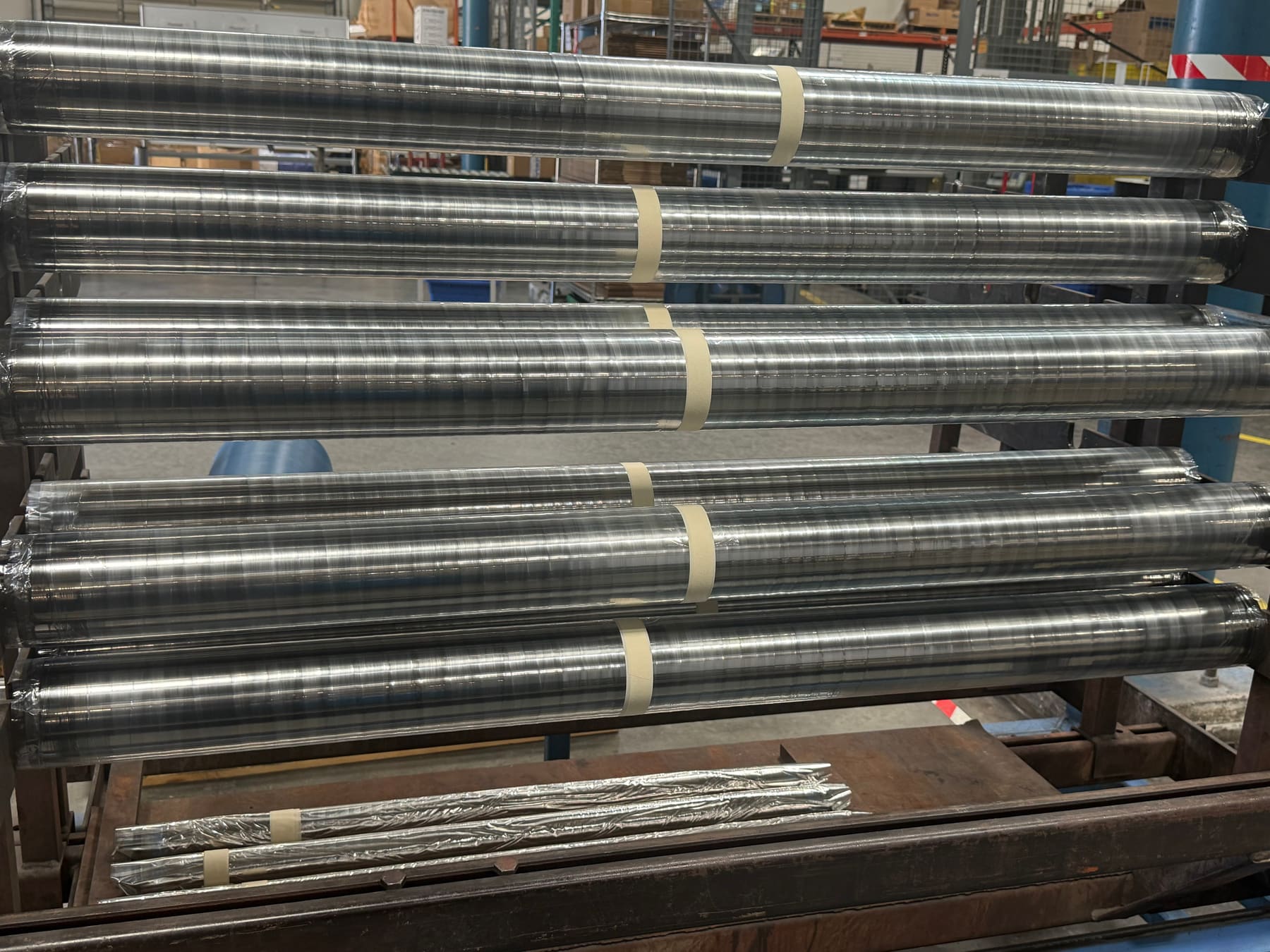
Mirror Chrome Finishes
Polished hard chrome for backing rolls, casting, and mirror finish calendar rollers where the roll surface transfers directly to the product.
-
Tacky Surfaces
Web-cleaning covers in multiple tack levels that lift dust and debris without marking sensitive surfaces. Available in silicone, polyurethane, and specialty elastomers.
-
Release Surfaces
Silicone and specialty compounds for adhesives, coatings, and heated materials that must not stick.
Coating & Plating
Hard Surfaces for Metal Rollers.
For metal rollers and roller surfaces that need hardness, corrosion resistance, or a specific finish, we specify and manage:
-
Hard Chrome Plating
Wear resistance and a smooth, durable finish for backing, coating, casting, heat-transfer, and chill rolls (chrome rollers and chrome rolls).
-
Nickel Plating
Corrosion resistance and a base layer for specific applications.
-
Anodizing
Surface hardness and corrosion protection for aluminum rollers and components.
Plating is also a reconditioning path. Worn chrome rolls can be stripped, re-plated, and re-ground back to spec, and we verify the finished chrome roll before it ships.
Material Matching
Match What’s Working. Fix What Isn’t.
If your current cover lasts, we can reproduce it. If it doesn’t, we can find out why.
When a roller comes in, we cut a sample of the existing cover and test it in the lab. That gives you two options:
-
Match It.
Reproduce the compound that’s been working so performance stays consistent, including on rollers we didn’t build.
-
Improve It.
If the cover is wearing out too fast, cracking, or swelling, we identify the cause and formulate a compound for the conditions it actually runs in.
The common case: a roller that comes back from every recover with the same cover and fails on the same schedule. The cover was being replaced. The cause wasn’t. Testing the old cover and formulating for the failure is what changes the cycle instead of repeating it.
The Real Cost
The Cover Is the Cheapest Part of the Roller, and the Most Expensive One to Get Wrong.
Downtime on a Precision Line
$10,000 – $100,000+ per hour
Against a line that runs this much when it’s down, the cost difference between a stock compound and one formulated for your conditions is small. The wrong one shows up as monthly change-outs, scrap before each one, and the spare you don’t have on the day it fails.
What the Right Cover Changes
-
Wear Life
A compound built for the conditions lasts longer between recovers.
-
Yield
No swelling, glazing, or sticking transferring into the product.
-
Uptime
Fewer change-outs, and predictable ones you can plan spares around.
-
One Less Variable
When the cover is right, the roller stops being the thing you troubleshoot.
Working With ABBA
The ABBA Engineering Promise
-
An engineer reviews your application, not a salesperson reading a script.
-
The compound is formulated for your conditions, not pulled from a shelf.
-
Every batch is tested in our own lab before it goes on your roller.
-
We’ll match what works, or tell you why it doesn’t and what to run instead.
-
Your drawings and specs stay protected. We work under NDA as standard.
-
The roller evaluation comes with a full report of what we found.

Why ABBA
Chemistry and Manufacturing, In-House.
- Our own compounding. Covers are milled in our facility, not bought in.
- Batch-tested. Every compound batch is checked for consistency before it’s used.
- Formulated for your process. Standard compounds or custom formulations from our material development team.
- Applied and ground by the same team. The people who choose the material also apply and finish it.
- ISO 9001:2015 certified. Quality management certified to the ISO 9001:2015 standard.
FAQs
Roller Covers & Surface Materials: Common Questions
What Is a Roller Cover?
What’s the Best Material for a Roller Cover?
How Do I Choose the Right Roller Hardness?
What Does Durometer Mean on a Roller?
Can You Match the Material on My Existing Roller?
Why Does My Roller Cover Keep Swelling or Cracking?
Do You Make Custom Rubber Compounds?
Do You Offer Food-Grade or FDA-Compliant Roller Covers?
Can You Re-Plate or Re-Chrome a Roller?
Can You Put a Different Cover on My Existing Roller?
Roller Evaluation
Tell Us What’s Wearing
Out Your Rollers.
We’ll find out why, and build a cover that lasts.