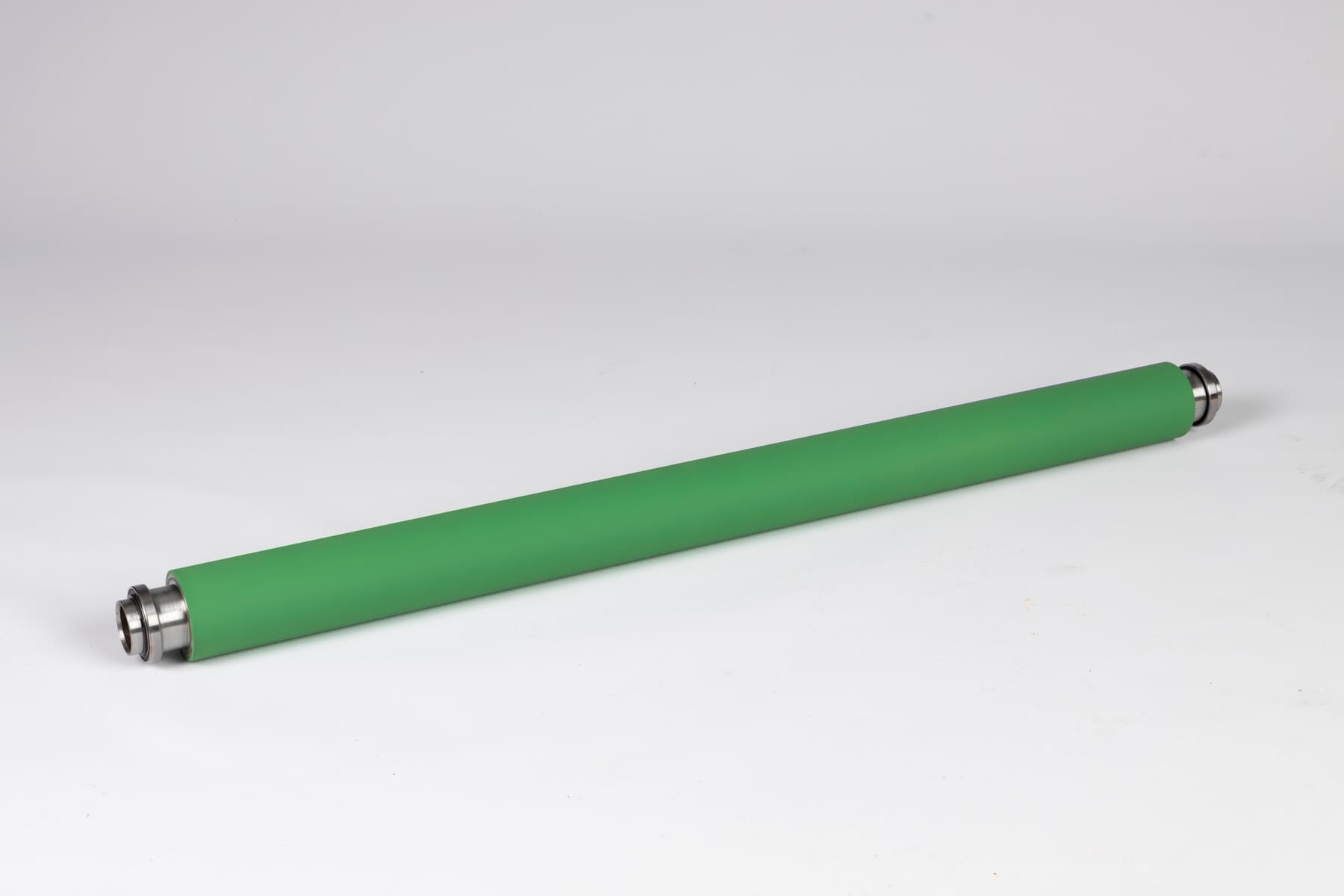
Precision & Process Rollers Engineered for Critical Processes
Each precision and process roller performs a critical function within the line, including nip pressure control, coating transfer, gauge consistency, heat transfer, traction, web support, alignment, and product contact.
Variations in roller geometry, surface finish, hardness, runout, crown, or material performance can create process instability, resulting in wrinkles, streaks, gauge drift, slip, uneven coating, surface defects, scrap, and unplanned downtime.
We engineer each roller around its application requirements, defining core construction, surface material, hardness, crown, geometry, surface finish, runout, balance, and critical tolerances.Before shipment, critical dimensions and surface requirements are verified against the approved specifications to support optimum performance and wear life.
Your request goes beyond a standard sales inquiry.
Our engineering team reviews the application and follows up promptly with technical feedback and next steps.
Since1959 Engineered Since 1959
2,000+ Formulations In-House, We Own Them
Inspection TIR to 0.0002″
ISO 9001:2015 Quality Management
Process Driven Specification
Basic Dimensions Are Only One Part of a Complete Roller Specification.
Diameter, face length, overall length, and journal dimensions define whether a roller fits the machine.
They do not define whether it meets the application’s performance requirements.
A complete roller specification must account for the conditions the roller sees in service, including load, speed, temperature, chemical exposure, nip pressure, web width, surface contact, traction, and wear environment.
Two rollers can match the same drawing and still require different materials, hardness, crowns, finishes, or tolerances based on where and how they run.
A roller specified by size alone can leave critical performance factors undefined. ABBA engineers each roller around both the mechanical dimensions and the process conditions that affect performance, stability, and wear life.
Premature Cover Wear, Swelling & Chemical Degradation
Why ABBA
Built Like an Engineering Partner.Responsive Like a Local Vendor.
Your roller is part of a larger process, so that is where we start. We work to understand your line at the application level: the chemistry, temperature, speed, tolerance, and wear behind each position, then engineer the roller around it, drawing on 2,000+ proprietary formulations we own and mill in house. National suppliers bring scale. Local shops bring speed. ABBA brings the combination your line actually needs.
Process Conditions Drive the Roller Specification.
Each process roller is engineered around defined mechanical, thermal, chemical, and operating requirements.
Load, speed, nip pressure, temperature, material compatibility, traction, and product contact determine the roller’s design and performance specifications.
These factors drive core construction, material selection, hardness, crown profile, surface finish, geometry, runout, balance, and dimensional tolerances.
Process Condition
Engineering Decision
Result
Load, pressure, web width
Core internals, journal or shaft design, & crown profile
Controlled deflection, reduced stress, and improved runnability
Temperature
Core material, cover compound, and surface selection
Maintains dimensional stability, hardness, and surface performance at operating temperature
Chemistry
Core & cover material selection
Resist corrosion, swelling, softening, cracking, and chemical degradation
Line speed & traction
Cover hardness, surface finish, coefficient of friction (COF) characteristics, and release properties
Maintains stable drive, tracking, and web handling without slip, chatter, or marking
Product quality requirements
Material compatibility, surface finish, profile, runout, and balance
Reduces product variation, marking, defect transfer, and chatter
Common Precision & Process Rollers
Explore Rollers by Function.
Explore common precision and process roller types by function, application conditions, and critical specification requirements.
Engineering, material development, fabrication, covering, precision grinding, finishing, and inspection are integrated under one roof in Ontario, California.
This allows us to maintain process control and align each manufacturing stage with the roller’s engineering specifications and application requirements.
Evaluate the Application.
We review the roller’s function, operating speed, load, temperature, chemical exposure, product contact, and performance requirements. Drawings, specifications, and existing roller information help define the engineering approach.
Operating Speed
Mechanical Loading
Operating Temperature
Chemical Exposure
Product & Web Material
Engineer the Design.
We develop or reverse-engineer roller designs from existing drawings, samples, or application requirements. Critical specifications are documented in approval drawings for customer review before manufacturing.
Key Capabilities
SolidWorks Design
Reverse Engineering
Approval Drawing Sign-Off
Material Selection & Compound Development.
We select or formulate rubber compounds based on chemical compatibility, thermal stability, hardness, compression behavior, and wear resistance. In-house mixing and batch testing support consistent material properties.
Key Capabilities
In-House Rubber Chemistry Lab
Custom Compounding & Quality Testing
Fabricate the Core.
We fabricate and machine roller cores, shafts, journals, and custom assemblies to approved design specifications. Core construction, material selection, and precision machining are matched to the mechanical and operating requirements of the application.
Key Capabilities
Custom Core Fabrication
Precision Shaft & Journal Machining
Precision Boring & Turning
Core Assembly & Welding
Custom Roller Construction
Covering, Curing & Precision Finishing.
Roller coverings are applied and cured using controlled manufacturing processes. CNC cylindrical grinding establishes the final diameter, crown profile, runout, and surface finish to meet the application specifications.
Key Capabilities
Cover Application & Curing
CNC Precision Grinding
OD & Crown Profile Control
Runout & Cylindricity Control
Surface Grinding & Polishing
Final Inspection & Verification.
Critical roller characteristics, including OD, cylindricity, runout, surface finish, and specified tolerances, are inspected against approved requirements before shipment.
Key Capabilities
Dimensional & Geometric Verification
Runout & Cylindricity Inspection
Surface Roughness Measurement
Non-Contact Laser Inspection
Quality Documentation as Required
Working With ABBA
The ABBA Engineering Promise
An engineer reviews your application, not a salesperson reading a script.
Your roller is engineered to its job in your process, not pulled from a catalog.
You sign off on the design before we build it.
Critical dimensions are verified before it ships.
Your drawings and specs stay protected. We work under NDA as standard.
The roller evaluation comes with a full report of what we found.
Capabilities
Your Specifications. Our Capabilities.
Roller Size & Capacity
40″Max. Outside Diameter
190″Max. Face Length
194″Max. Overall Length
10,000 lb (5 Tons)Max. Roller Weight
Engineering Capabilities
SolidWorks Design Engineering
Reverse Engineering
Build-to-Print Manufacturing
OEM Specification Replacement
Approval Drawing Review & Sign-Off
Load, Stress & Deflection Calculations
Core & Journal Design
Crown & Profile Development
Tolerance Development & Verification
Constructions
Dead Shaft
Live Shaft
Single-Shell Construction
Dual-Shell Construction (Including Spiral Baffle)
Bowed Rollers (Fixed / Adjustable)
Custom Core & Journal Construction
Coverings, Coatings & Surface Technologies
Rubber & Polyurethane Coverings
Natural Rubber (NR)
Styrene-Butadiene Rubber (SBR)
Nitrile Rubber (NBR)
Neoprene (CR)
EPDM
Hypalon® (CSM)
Silicone (VMQ)
Fluoroelastomer (FKM)
Cast & Millable Polyurethane
Metal Plating & Surface Treatments
Hard Chrome Plating
Nickel Plating
Hardcoat Anodizing
Specialty Coatings
Tungsten Carbide Coatings
Ceramic Coatings
Thermal Spray & Plasma Coatings
PTFE & Release Coatings
Wear-Resistant Coatings
Traction & Slip-Control Coatings
Specialty Coverings
PTFE / Teflon Sleeves
Specialty Release Coverings
Quality & Verification
ISO 9001:2015 Certified
Critical Tolerance & Dimensional Verification
In-House Compound Batch Testing
Precision Metrology & Laser Inspection
Final Quality Inspection
Industries
Precision & Process Rollers Engineered for Different Industries.
Explore precision & process roller positions by industry.
A process roller is any roller that performs a specific job in a manufacturing line, such as laminating, coating, calendering, heating, cooling, driving, guiding, or squeezing. The right design depends on that job, the load and speed it runs at, the temperature, and the materials and chemistry it touches.
What Makes a Roller a “Precision” Roller?
A precision roller is engineered and manufactured to critical geometric specifications, including diameter, cylindricity, runout, straightness, surface finish, and balance. It is used in applications where roller variation directly influences product quality, process repeatability, and manufacturing performance. See Precision Rollers.
How Do I Choose the Right Cover for My Roller?
It depends on temperature, chemistry, speed, load, and the surface the roller contacts. Our Roller Covers & Surface Materials page walks through the options, or an engineer can recommend one for your application.
Can You Build a Roller From My Old Roller or Drawing?
Yes. We reverse-engineer existing rollers and build to print from customer or OEM drawings. On new fabrications you approve the drawing before we start.
How Long Does a New Process Roller Take?
Lead time depends on the roller design, materials, manufacturing complexity, and any required outside processes. Typical lead times range from 4 to 12 weeks, with expedited options available when feasible.
Do You Only Make New Rollers?
No. We also recover, repair, regrind, and recoat existing rollers. Restoring the core is often faster and more cost-effective than replacing the whole roller. See Recover, Repair & Reconditioning.
How Do I Get Started?
Request a roller evaluation, or upload a drawing. Share the application, the problem you’re seeing, and any photos, and an engineer will follow up.
Roller Evaluation
Let’s Review Your Application.
Send us your roller details, drawings, specifications, or a description of the issue. We’ll review the information and recommend the next steps.